
Become a founding member —Pro free for 12 months when payments launch

Medication-aware skincare

Using skincare while taking medication? Get clear answers in seconds.

Find out what’s safe, what needs caution, and what to avoid—in seconds.

See How It Works

Common searches today

Free safety checks · No credit card · Built for US consumers

Why BlendSafe

Every verdict links to its source.

Each interaction is checked by our PharmD co-founder against the FDA label or published research before it's shown. If we can't cite it, we don't show it.

Answered in seconds

Common questions we answer instantly

Real questions people search every day — each answered live by the same interaction engine that powers the checker.

AvoidRetinol

Can I use retinol while on Accutane?

Do not combine topical retinoids with isotretinoin.

No label conflict foundVitamin C

Is vitamin C okay with tretinoin?

We don't have verified data on this combination yet.

No label conflict foundBenzoyl Peroxide

Benzoyl peroxide with tretinoin?

We don't have verified data on this combination yet.

No label conflict foundGlycolic Acid

Glycolic acid while taking doxycycline?

We don't have verified data on this combination yet.

No label conflict foundNiacinamide

Can you use niacinamide with tretinoin?

We don't have verified data on this combination yet.

No label conflict foundAHAs

Can I use AHAs while on Accutane?

We don't have verified data on this combination yet.

More ways to check

Understand your entire routine, not just one product.

See how a medication may affect morning, evening and occasional skincare products—then review the reason behind every flag.

Full routine check

Check your complete routine

A sample routine showing how BlendSafe can flag products that may increase dryness, irritation or sun sensitivity.

Example medicationOral isotretinoin
  • Gentle cleanserHydrating · fragrance-freeRecommended
  • Vitamin C serumMay feel too harshAvoid unless approved
  • Barrier moisturizerCeramides · hydrationRecommended
  • Broad-spectrum SPF 30+Daily sun protectionRecommended
3 recommended · 1 should be reviewed

Isotretinoin can make skin dry and sensitive. A gentle cleanser, moisturizer and daily sun protection support the skin barrier.

Select a routine to explore the example.Check my complete routine
Explore specific interactions

Review common medication and skincare combinations with the context behind the result.

Potential irritation risk

Avoid unless approved

Topical retinol can irritate skin that is already dry and sensitive during oral isotretinoin treatment.

Educational information only. Results should explain potential concerns and supporting evidence; they do not replace a dermatologist’s advice or an individual treatment plan.Product formulation and personal tolerance matter.
How it works

Three steps. No spreadsheets.

We do the cross-referencing so you don't have to deep-dive ingredient lists at midnight. Just two inputs, one verdict, and the science one tap away.

01

Tell us your medication

Pick from acne, rosacea and dermatology prescriptions.

Live preview
AccutaneDoxycyclineTretinoinSpironolactone
02

Search your skincare

Find by product name or paste in the ingredient list.

Live preview
Cera
03

Get a clear verdict

Green, yellow or red — with the science explained.

Live preview
No label conflict foundCAUTIONAVOID
Browse by category

Pick your medication category

Hover any card
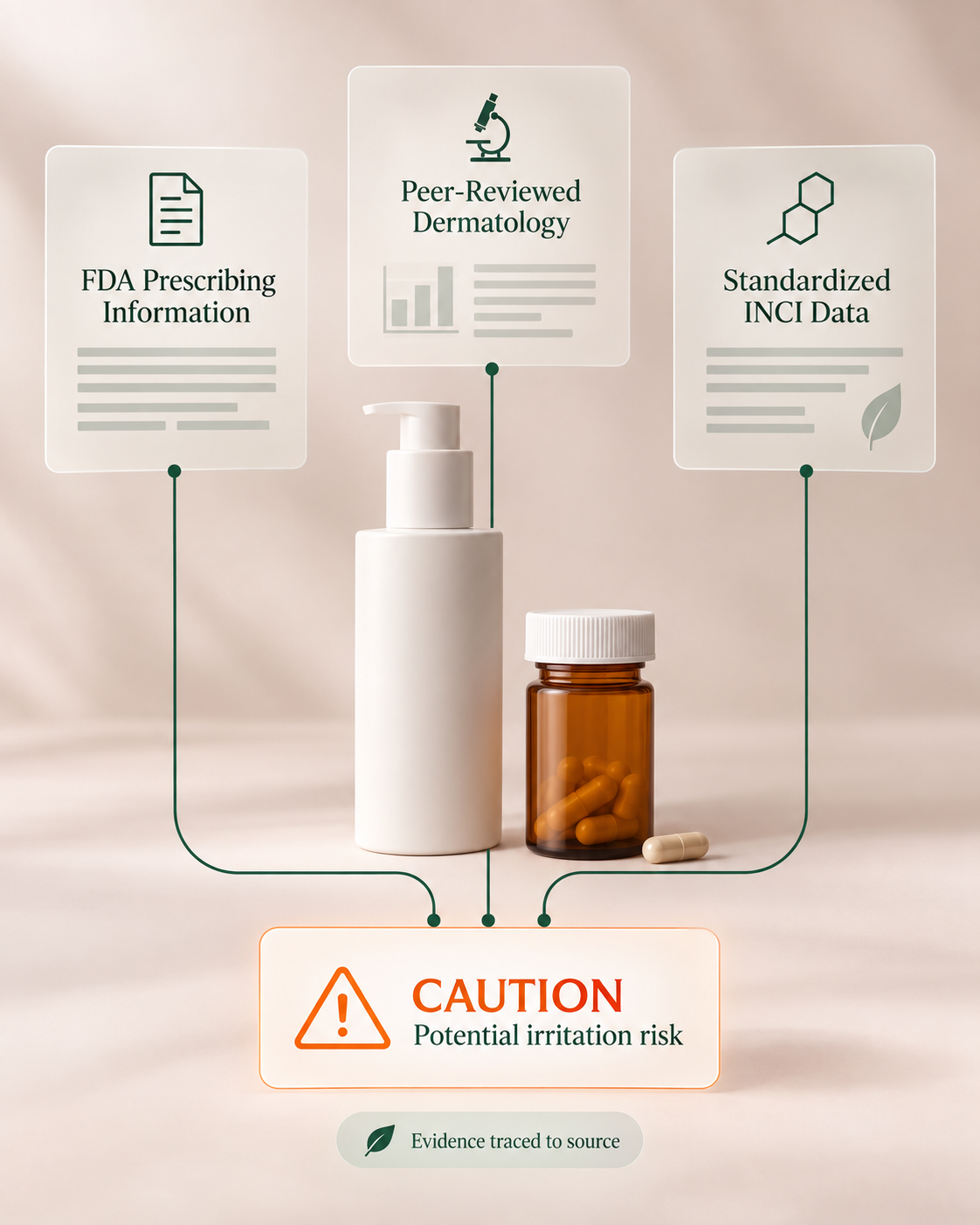
Medication and skincare product connected to prescribing information, dermatology research and ingredient data, producing a caution result
Evidence mapped to each resultTrusted sources

The evidence

Built on dermatology evidence — not influencer hot takes.

BlendSafe compares your medication with the ingredients in your skincare product using official drug information and trusted dermatology sources. Every result explains why a combination is generally compatible, needs caution, or should be avoided—with supporting sources included.

01

Medication information

Warnings, adverse effects and precautions from official medication information.

FDA source ↗
02

Dermatology guidance

Clinical guidance adds context for irritation and skin-barrier concerns.

AAD source ↗
03

Ingredient analysis

Product-label ingredients are normalized for consistent comparison.

Naming source ↗

Important: A standardized ingredient name identifies what is present. It does not mean that an ingredient or product is FDA-approved or suitable for every person.

01Standardized ingredients

Normalized from the product label.

02Peer-reviewed sources

Dermatology literature and guidance.

03Drug-label data

Source and review date displayed.

04Never sponsored

Commercial relationships do not change results.

Example compatibility checks

See the reasoning,
not just a badge.

Select an example to see the reason, lower-risk approach and evidence used. These examples are educational—not personal medical advice.

Evidence trace 01 / 06Avoid

Isotretinoin (oral)×Retinol 1% serum

Avoid unless your dermatologist specifically approves it.

The American Academy of Dermatology advises avoiding topical retinol while taking isotretinoin because isotretinoin makes skin more sensitive and retinol can add irritation.

Important context: This is an additive irritation concern—not a claimed drug interaction. Your prescriber’s instructions take priority.

Why this result

Both belong to the retinoid family. During isotretinoin treatment, dryness and skin sensitivity are common, making extra retinoid exposure harder to tolerate.

Lower-risk approach

Use a gentle cleanser, non-comedogenic moisturizer and broad-spectrum SPF 30+. Reintroduce actives only with dermatologist guidance.

Medical information, not medical advice. BlendSafe supports—not replaces—care from a licensed clinician. Never stop or change a prescribed medication without consulting the prescriber.Sources accessed September 2026
Know before you layer

These combinations can increase irritation or other risks

High-interest pairings people ask about most — with the clinical reason spelled out in plain language.

No label conflict found

Tretinoin × Glycolic Acid

We don't have verified data on this combination yet.

Avoid

Isotretinoin × Vitamin A supplement

Do not combine topical retinoids with isotretinoin.

No label conflict found

Benzoyl Peroxide × Retinol

We don't have verified data on this combination yet.

After launch

What unlocks after launch.

BlendSafe is evolving from a quick checker into a personalized skincare safety system.

  • Premium feature

    AI Routine Builder

    Build a safe skincare routine around tretinoin, sensitive skin, acne, or barrier repair.

    Currently in development
  • Premium feature

    Saved Routine Vault

    Save AM/PM routines, track products, manage active ingredients, and monitor medication compatibility.

  • Premium feature

    Continuous Routine Monitoring

    We'll warn you if your updated routine increases irritation risk — proactively, between checks.

    Currently in development
  • Premium feature

    Extended Scanning Access

    Premium unlocks significantly more ingredient scans and advanced photo + barcode analysis.

  • Premium feature

    Dermatologist PDF Exports

    Generate medication conflicts, ingredient summaries, and routine breakdowns as a dermatologist-ready report.

  • Premium feature

    Personalized Skin Logic

    BlendSafe remembers sensitive skin, rosacea, acne-prone, eczema, and pregnancy-safe needs — every check becomes personalized.

    Currently in development
  • Premium feature

    Weekly Skin Safety Digest

    Email updates on new ingredient warnings, trending risky combinations, skincare education, and safer alternatives.

    Currently in development

Free safety checking stays open at launch — premium adds memory, continuity, personalization, and intelligent monitoring.

Pricing

Free safety checking. Premium skincare intelligence.

BlendSafe stays free for safety checks. Premium adds memory, continuity, and intelligent monitoring when you’re ready.

FREE TO START

Try BlendSafe free

Run safety checks, browse ingredients, and use core compatibility tools. No card to begin.

  • Free safety checks to start
  • Barcode + photo ingredient scan
  • Instant safety verdict
  • 1,500+ products covered
  • Built for US consumers
Most loved

FOUNDING MEMBERS

Premium intelligence

Memory, continuity, and personalized monitoring — the premium platform after launch.

  • Saved AM/PM routines + history
  • Personalized skin logic (sensitive, rosacea, pregnancy-safe)
  • Continuous routine monitoring
  • Dermatologist-ready PDF export
  • Extended scanning + advanced analysis
  • Pro free for 12 months when payments launch

Founding member

Become a founding member

Pro free for 12 months when payments launch. Be the first.

Frequently asked

Frequently asked questions

Answers about how BlendSafe works, what each verdict means, and how to use it alongside your medications and dermatologist.

Stop guessing. Start checking.

In under 10 seconds see whether tonight's serum conflicts with your prescription's label. No credit card.